This is Stadium.
With a vision to activate the world, Stadium aims to inspire everyone to lead an active life.
Stadium Group.
Stadium is Sweden’s largest sports chain with approximately 180 stores in Sweden, Finland and Norway.
The Stadium Group consists of the concepts Stadium and Stadium Outlet, which together have approximately 180 physical stores and their respective e-commerce platforms. Together, they form Sweden's largest chain for sports and sports fashion. The headquarters of the Stadium Group, referred to as the "service office," is located in Norrköping and aims to support all stores and customer service. The company is owned by the Eklöf family and operates in Sweden, Finland, and Norway.
Stadium was the original concept launched over 30 years ago and now includes several specialty stores such as Stadium Ski and Stadium Plus. Stadium Outlet offers lower prices than the market in general thanks to larger bulk purchases.
Since 1995, Stadium Sports Camp has been organized for children and youth. Stadium Sports Camp has its own organization and operates as an SVB company (special profit distribution restriction), which means that Stadium Group reinvests and distributes all profits to participating clubs. Annually, around 7,000 children are engaged during the camp weeks.
With a vision to activate the world, Stadium aims to inspire everyone to lead an active life.
Join the movement.
Board & Group Management.
Board Stadium Group
Karl Eklöf CEO
Kristina Skoog Rappestad P A to CEO
Sophia Hemstad CFO
Daniel Johansson Supply chain Director
Fredrik Persson CDO
Daniel Löfkvist COO
Pino Roscigno Commercial & Brand Director
Miranda Nanhed Purchase & Category Director
Ida Törneke HR & Sustainability Director
Group Management Stadium AB
Anders Svensson Chairman
Madeleine Persson
Jesper Schmidt
Ulf Eklöf
Bo Eklöf
Karl Eklöf
Linda Palmgren
Andrea Gisle Joosen
How it all started.
The story of Stadium.
Growing up in his parents’ grocery store in Norrköping, Ulf Eklöf learned early what business really meant – not in theory, but in practice. Customer by customer. Transaction by transaction. When he wasn’t helping out in the store, he spent his winters in the local slope with skis carving through the snow, long before any talk of brands or business plans.
By 1974, that dual passion – for retail and for sport – had crystallised into something more ambitious. Ulf set his sights on a bold idea: to become the best in sports and sports fashion.
While still studying at the Stockholm School of Economics, he made his first decisive move, acquiring Spiralen Sport in Norrköping. It was, by all accounts, a typical store of its time. Goods were kept behind the counter and the service was formal. But that wouldn’t last.
When his younger brother Bo joined a few years later, the pace quickened. Together, fuelled by instinct, energy and a willingness to challenge convention, they began rethinking what a sports store could be. Not just a place to buy products –but a destination, an experience.
One store turned into several. Different concepts were tested across Sweden. And gradually, an idea took hold – bolder than anything they had done before: a large-scale sports retail space in the heart of Stockholm.
On March 25, 1987, the doors to The Stadium opened on Sergelgatan in Stockholm.
From the very first day, it was clear that something had shifted. Customers came – not just to shop, but to explore. To engage. To experience sport in a new way. The success was immediate, and as they say in sport: from there, the rest is history.
Today, Stadium stands as one of Northern Europe’s leading sports retailers. What began as a single store has grown into a network of more than two hundred locations across Sweden, Finland and Norway. But growth hasn’t been the only constant – reinvention has.
New ideas continue to shape the company: Stadium Team Sales, Marketplace, Stadium Outlet, Stadium Rental, Stadium Run, Stadium Ski. Each one part of a broader ambition encapsulated in a simple vision: to activate the world.
And perhaps nowhere is that vision more tangible than at Stadium Sports Camp.
Launched in 1995, it has grown into Sweden’s largest – and arguably most joyful – sports camp for children and teenagers. Every summer, thousands gather not just to train, but to discover. New sports. New friendships. New confidence. Structured as a company with limited profit distribution, a significant share of its surplus is reinvested into the sporting community. To date, nearly SEK 65 million has been distributed to partner organisations.
Stadium enters the 21st century.
2000 – The first step beyond Sweden: Copenhagen. A store opens at Fisketorvet, marking the beginning of Stadium’s international journey.
2001 – Finland follows, with a flagship presence in Forum, right in the heart of Helsinki.
2005 – The launch of the “Activity Bag”. Each year, thousands of first-grade children across Sweden receive a bag filled with sports equipment - an invitation to move, to play, to begin.
2006 – A new central warehouse is inaugurated in Norrköping. Strengthening the backbone of the growing operation.
2007 – Stadium steps into the digital arena with the launch of its online store.
2009 – A new concept emerges: Stadium Outlet. The first store opens in Örebro.
2013 – Sustainability moves into focus. Stadium publishes its first sustainability report, signalling a broader responsibility.
2015 – Stadium Outlet expands into Finland, opening in Tammisto.
2017 – “Order in Store” now connects customers to the full range, blurring the line between physical and digital. By now, the company has nearly 170 stores and 3,500 employees. Stadium Sports Camp reaches a milestone with 100,000 participants.
2019 – Stadium introduces its Fair Play Award at the Swedish Sports Awards. Meanwhile, Norway joins the Outlet expansion, with stores opening in Kristiansand and Moss.
2020 – A new robotised warehouse comes fully online, built to meet the demands of a rapidly growing e-commerce landscape.
2021 – Stadium Outlet launches online in Norway, while Stadium Connect opens the digital doors to partner brands - transforming the site into a broader marketplace.
2022 – From products to services: Stadium Rental launches ski and snowboard rentals in Åre, expanding to Sälen the following year.
2024 – More than 200 stores in three countries. And a brand that has become one of Sweden’s most recognised and most appreciated.
Stadium – The story.
Thirty years have passed since the Eklöf brothers founded their family business. Today, Stadium stands as one of Sweden’s most recognised and well-loved brands.
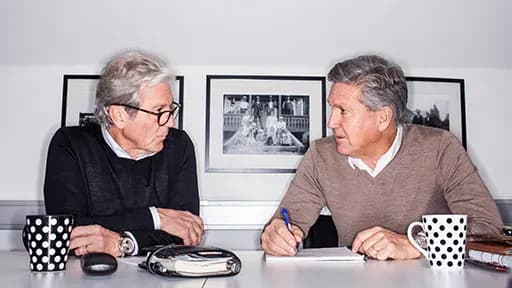
The story of Stadium begins as early as 1974, when Ulf Eklöf took over the small sports shop Spiralen Sport in Norrköping. His brother Bo soon joined him, and together they set out to redraw the map - not only for how a company could be built, but for what a sports retailer could be. Fifty years later, Stadium operates more than 200 stores across three countries and has become one of Sweden’s most recognised and appreciated brands.
There are family businesses, and then there are family businesses. And then there is Stadium. On the surface, it looks like a classic family-run company, where the son of one of the founders has stepped in as CEO. But there’s also something that sets it apart from the norm - something that has led to comparisons with IKEA and H&M, and that even makes the founders themselves, brothers Ulf and Bo Eklöf, feel that only “30 or 40 years’ head start” separates those giants from Stadium.
To call it confidence alone would be too simple. There is something else at play - a kind of creative friction that runs through the company’s 50-year history and is almost tangible when you meet the brothers. Restless and energised, they finish each other’s sentences, constantly affirming each other’s passion. It’s a friction that fuels doubt about established paths and challenges anything taken for granted - things that can often become traps for family businesses. It’s also why, in the early 2000s, a seven-year plan for a stock market listing was put in place.
“But we stopped it early,” says Ulf, the older brother. “We realised that the financial markets, with their volatility, would be wrong for us - for our entire approach built on long-term thinking and patient investment. But we really needed to test the idea seriously, together with external stakeholders, to reach that insight.”
Stadium always finds its way back to its identity.
A similar process unfolded in 2008, when Ulf felt it was time to step down as CEO. Many assumed that his son, Kalle Eklöf, then 33, would take over. Instead, Stadium recruited an external CEO for the first time. Ulf says it “felt like Kalle wasn’t quite ready yet,” but as he reflects on that period, there is just as much a sense that he himself wasn’t ready.
Had Kalle taken over immediately, Ulf might have found it harder to keep his hands off day-to-day decisions.
“I stepped down because I really needed to slow down and focus on other things,” he says. “When Gustaf Öhrn came in as CEO, I stayed one floor up and told him: ‘Knock on my door if you want my input.’”
Eight years later, after a fiercely competitive recruitment process against two other candidates, Kalle Eklöf was finally appointed CEO. His competitive instinct and solid expertise helped secure the role - and with him at the helm, another chapter in the company’s story began.
In other words, Stadium always returns to its identity as a firmly rooted family business - but one driven by constant self-examination and an inability to sit still (quite literally - the Eklöf brothers jump up from their chairs several times during the interview). They willingly throw themselves into unfamiliar territory, driven by curiosity and a need to test ideas before building decisions on them.
“We’ve probably always done things that way?” Bo says, turning to Ulf.“Yes,” Ulf agrees. “We test first - we’re almost always quick off the mark. We like learning things from the ground up, and the fact that we’re sometimes beginners only motivates us. Like when we learned how to build our logistics, or when we bought a clothing chain and learned everything about production - that laid the foundation for our in-house brands, which now set us apart. We need to build from our own experience when we analyse and form strategies. So the first step for us has never been a perfectly defined plan.”
It took several years before they even began working with purchasing budgets.
“We just went for it. Because we had an extremely detailed understanding of the business, we could grow by 50 or 60 percent in a single year, instead of maybe 20 percent if we had followed strict budgeting. That impatience has allowed us to invest quickly, change direction, and push forward.”

The secrets behind the success.
Interviewing the Eklöf brothers means being prepared to find contradictions in your notes. Within seconds, they might describe themselves as both “patient” and “impatient.” But once you understand how they operate, the pattern becomes clear. These contradictions are simply different strengths applied in different situations. A better word is flexibility. Another is humility.
Like when they decided to exit Denmark after more than 15 years and considerable patience.
“It’s all connected,” says Bo Eklöf. “Without mistakes, we wouldn’t have become this successful. And without success, we wouldn’t have been able to afford such valuable mistakes…”
“In Denmark, we made the classic mistake of underestimating climate differences,” Ulf continues. “And I mean both that our winter sports profile had little value in a warmer climate, and that the market is far more locally driven and small-scale.”
Shortly after leaving Denmark, they made a new push into Finland. When one of Helsinki’s best retail locations became available, the brothers acted quickly. There were inevitable challenges, but with experience from multiple markets, they were able to learn and adapt quickly. Stadium grew significantly in Finland and now operates around 50 stores. With the ambition to become the leading destination for active living in the Nordics, Stadium Outlet was also launched in Norway in 2019.
A drive to be the best.
It’s striking how all of Stadium’s cornerstones trace back to their upbringing - including the focus on sport. Their mother had a deep passion for sports and the outdoors, along with a strong competitive streak: “Do whatever you want - but be the best,” she would say.
When they weren’t in school or competing in the store, they were on football pitches, tennis courts, or skiing - sometimes with neighbour “Plura” Jonsson, later a famous musician and TV personality.
“As recently as last night, my brother and I competed in a game of boules,” says Bo. “But it’s more relaxed now.”
“Yes,” says Ulf after a reflective pause. “For me, that drive to compete and win has evolved into curiosity. Maybe competitiveness is really just curiosity about how good you can become - whether you can beat your opponent, and how long you can stay on top.”
That mindset was already in place when Ulf bought Spiralen Sport in 1974, at just 22 years old, studying business in Gothenburg, with his first child on the way. With help from mentor Ulf Calmfors, who arranged a loan of 200,000 kronor, the journey began. Bo joined in 1976.
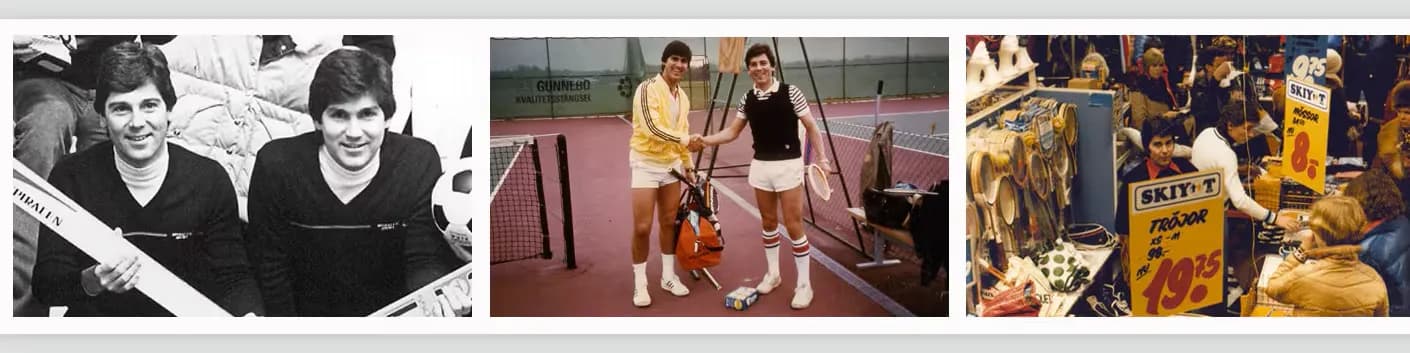
Calmfors would prove instrumental. One defining moment came with a deal involving Skiyot jackets - highly fashionable at the time and sold in Stockholm for 600-800 kronor.
The brothers initially planned to buy 200 jackets. But during negotiations, Calmfors intervened:
“How many garments are we talking about in total?” he asked.“12,000,” came the reply.“What’s your price for all of them?”
The brothers were stunned. But the deal went through at 59 kronor per jacket - a breakthrough moment.
“The most important lesson,” says Ulf, “was pricing: If you buy cheap, you sell cheap. Never squeeze out the last margin.”
Curiosity and competitive instinct.
Spiralen Sport became a major success in Norrköping. The 1970s and 80s were a golden age for sports culture, with Borg, Stenmark, aerobics, jogging, and national teams capturing the public imagination. Fashion began merging with sports retail - and the Eklöf brothers thrived in this dynamic environment of trends, bold sales tactics, and hands-on execution.
Sometimes they made mistakes - what they called “buying bananas.” But those missteps were part of the journey.
“Today, the challenge lies more in our identity,” says Ulf. “Copies aren’t enough. We combine the best global brands with our own, like Everest and SOC. And we work hard on store differentiation - understanding the balance between target groups and assortments. But we’ve also kept that sense of a great deal alive through Stadium Outlet.”
Curiosity remains a constant theme - the restless desire to understand the limits of the concept. In 1983, that curiosity brought them to Stockholm, where they acquired the Race Marine store. Ulf meticulously tracked the relationship between weather, sales, and advertising, refining the formula until the store itself became a weekend destination. At times, crowds were so large that only a few customers could be let in at once.

A success story since 1987.
Further acquisitions followed - including the clothing chain Askling, later renamed and developed, and Red Devil in 1985. These experiments eventually led to the launch of Stadium in 1987 - and a spectacular opening featuring security guards, autograph sessions with Ingemar Stenmark, and a record-breaking first-day revenue of 1.6 million kronor. Break-even for the year was set at 35 million - the result: 65 million.
When Ulf describes it as “the market’s most advanced sports retail concept,” it sounds almost understated.
Everything fell into place - the entrance, the running track, the interior design inspired by gym equipment, and the influence of American sports aesthetics.
“We felt at home immediately,” says Bo.
And that sense of momentum has continued ever since. Today, Stadium operates more than 200 stores and six online platforms across three countries, with turnover in the billions. Creative collaborations with leading designers have shaped the brand, while its leadership style continues to reflect that same forward-leaning curiosity.
“It’s not for everyone,” says Ulf. “That goes for our own families too. Some go all in, others simply don’t have the interest or personality for retail. But like any great team, we build around shared values - knowledge, flexibility, and humanity.”
That culture is perhaps best captured in the Stadium Olympics - a company-wide event held every two years in Norrköping. What started as a playful staff activity after closing hours has grown into a major celebration involving employees from Sweden and Finland. While many companies try to engineer culture from the top, Stadium’s has evolved organically.
And that, in essence, is how Stadium works:
Simple. Natural. Social.And driven by an unwavering passion for an active lifestyle.